
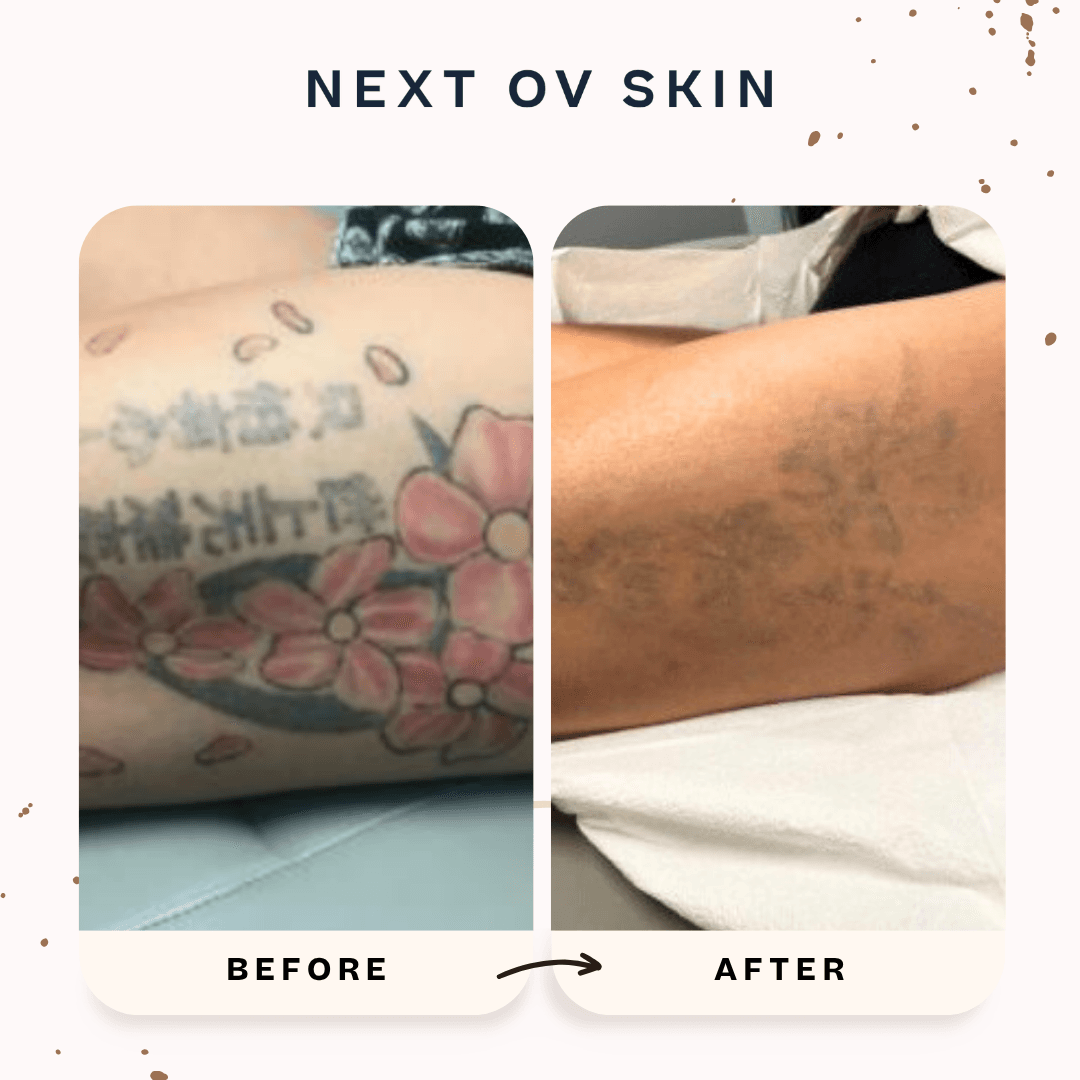
The short answer is that many tattoos can be removed to the point where they are no longer noticeable in everyday life. Some clear completely. Others fade so significantly that only faint traces remain — traces that most people would not notice unless they knew exactly where to look.
But the honest answer is more nuanced. Full removal depends on several factors, and outcomes vary from person to person. Understanding what influences clearance can help you set realistic expectations and make informed decisions about your treatment.
What Does Full Removal Actually Mean?
When people say they want a tattoo fully removed, they usually mean they want it gone — invisible, erased, no trace left behind.
In practice, full removal can mean different things:
- Complete clearance — The ink is no longer visible. The skin looks clear, with no obvious remnant of the tattoo.
- Near-complete removal — Most of the ink is gone. Faint shadows or subtle texture changes may remain, but they are difficult to notice without close inspection.
- Significant fading — The tattoo is dramatically lighter. It may still be faintly visible, but far less prominent than before.
For many people, near-complete removal is indistinguishable from full removal in everyday life. The tattoo no longer draws attention. It no longer defines that part of the body. That is often enough.
Others want every last trace gone. That is a reasonable goal, and it is achievable for many tattoos — though it may require more sessions and more patience.
Can Every Tattoo Be Fully Removed?
Most tattoos can be significantly faded, and many can be fully cleared. But not every tattoo responds the same way.
Some tattoos are easier to remove than others. Some will clear quickly and completely. Others may leave subtle residual marks even after extensive treatment.
The difference usually comes down to factors like:
- The type and quality of ink used
- The colors in the tattoo
- How densely the ink was applied
- Where the tattoo is located on the body
- How old the tattoo is
- Your skin tone and how your body responds to treatment
Understanding these factors can help you anticipate what your own tattoo removal journey might look like.
Factors That Affect Whether a Tattoo Can Be Fully Removed
Ink Color
Black ink is generally the easiest to remove. It absorbs laser energy efficiently and tends to break down well over multiple sessions.
Darker blues and greens often respond reasonably well, though they may take longer than black.
Lighter colors — yellow, white, light blue, and some pastels — are more challenging. They reflect more light and absorb less laser energy, which makes them harder to fragment. Some light inks may fade but not fully disappear.
If your tattoo is primarily black or dark-colored, full removal is often very achievable. If it includes lighter colors, those areas may require more sessions or may fade less completely.
Ink Density
Heavily saturated tattoos — solid fills, bold lines, dense shading — contain more ink per square inch. That means more ink to break down and more sessions to clear it.
Lighter, more delicate tattoos with fine lines or subtle shading often respond faster. There is simply less ink for the body to process.
Professional vs. Amateur Tattoos
Professional tattoos are typically applied more evenly and more deeply into the skin. The ink is often higher quality and more densely packed. This can make them more resistant to removal, even if they look similar in size to amateur work.
Amateur tattoos — including stick-and-poke tattoos — are often applied less evenly and at shallower depths. They may clear faster, though results vary.
Tattoo Location
Tattoos closer to the heart tend to clear more efficiently. The chest, upper arms, and upper back have stronger circulation, which helps the lymphatic system carry away fragmented ink.
Tattoos on the extremities — hands, feet, ankles, lower legs — often take longer. Blood flow is slower in these areas, and healing can be more variable.
This does not mean tattoos in difficult locations cannot be fully removed. It just means the process may take more time and more patience.
Tattoo Age
Older tattoos have often faded naturally over time. The body has already begun breaking down the ink, and the remaining particles may respond more readily to treatment.
Newer tattoos — especially those less than a year old — tend to have denser, more intact ink. They may take longer to clear, though they can still be successfully treated.
Skin Tone
Tattoo removal works by targeting pigment. On darker skin tones, we need to carefully protect the melanin in the skin while still breaking down the ink underneath. This often calls for lower energy settings and a more cautious treatment pace.
With the right approach, tattoo removal can still be very effective on darker skin. It may take longer, and the risk of pigmentation changes needs to be carefully managed, but full or near-complete removal is often achievable.
Learn more in our guide to tattoo removal for dark skin.
Scarring or Texture Changes from the Original Tattoo
Some tattoos cause subtle scarring or texture changes when they are first applied — especially if the tattoo was applied too deeply, healed poorly, or was worked over multiple times.
Laser treatment removes the ink, but it cannot remove scar tissue that was already there. If your tattoo has raised areas or textural irregularities, those may remain even after the ink is gone.
This is not common, but it is worth knowing. During your consultation, we can assess whether your tattoo shows signs of pre-existing scarring.
What Realistic Outcomes Look Like
For most people pursuing full removal, the outcome falls into one of these categories:
Complete clearance — The tattoo is gone. The skin looks normal. This is achievable for many tattoos, especially those that are primarily black, moderately dense, and located in areas with good circulation.
Near-complete removal with faint residual marks — The vast majority of the ink is gone. What remains is subtle — perhaps a faint shadow, slight discoloration, or minor texture variation. Most people find this outcome very satisfying.
Significant fading with some visible remnants — The tattoo is dramatically lighter but still faintly visible upon close inspection. This is more common with multicolored tattoos, very dense tattoos, or tattoos in difficult locations.
It is important to go into treatment with realistic expectations. If full clearance is your goal, it is often achievable — but it may take time, and there are no guarantees.
If you would be satisfied with near-complete removal or significant fading, you may reach your goal faster and with fewer sessions.
How Long Does Full Removal Take?
The number of sessions needed varies widely. Small fine-line tattoos and eyebrow tattoos may sometimes show meaningful improvement in as few as 2 to 3 sessions. Lined or moderately dense tattoos can often be significantly faded in about 3 to 5 sessions. Very dense tattoos, heavily saturated pieces, or tattoos on the hands and feet often take 6 to 8 sessions or more.
For many tattoos, full removal may take somewhere in the range of 8 to 12 sessions. But not every tattoo needs that many.
We recommend at least 12 weeks between tattoo removal sessions. Ink will continue to clear for months, so waiting a little longer rather than treating too close together often gets you more out of each session.
Learn more in our guide to how many tattoo removal sessions you may need.
If you are also weighing the investment involved, read more about tattoo removal cost.
What If Full Removal Is Not Possible?
In rare cases, a tattoo may not fully clear — usually because of stubborn ink colors, very dense saturation, or pre-existing scarring.
Even then, significant fading is almost always achievable. And for many people, that is enough.
If full removal turns out not to be realistic for your tattoo, you still have options:
- Accept near-complete removal — The tattoo is far less visible than before, even if faint traces remain.
- Plan a cover-up — Strategic fading can give a tattoo artist a much better canvas to work with. You may not need full removal to get the new artwork you want. Learn more in our guide to tattoo removal for cover-up.
- Stop when you are satisfied — You are in control of the process. If you reach a point where the tattoo no longer bothers you, you can stop treatment.
How We Help You Understand What to Expect
During your first visit, we assess your tattoo and talk honestly about what realistic outcomes might look like for you.
We consider:
- The size, location, and age of the tattoo
- The colors and density of the ink
- Your skin tone and health factors
- Your goals — full removal, near-complete fading, or preparation for a cover-up
We will not promise complete clearance if we do not think it is likely. But we can give you a realistic sense of what is achievable and help you decide whether treatment is right for you.
If you are considering laser tattoo removal in Edmonds, we are here to answer your questions and help you understand what your journey might look like.
The Bottom Line
Can tattoos be fully removed? For many tattoos, yes. Complete clearance is a realistic goal, especially for black or dark-colored tattoos that are moderately dense and located in areas with good circulation.
For others, near-complete removal or significant fading is more realistic — and often just as satisfying.
The best way to know what is possible for your tattoo is to have it assessed in person. Every tattoo is different, and outcomes depend on factors that are not always visible in photos.
What we can say is this: if you are carrying a tattoo you no longer want, there is almost always something we can do to help. Whether that means full removal, meaningful fading, or preparing your skin for new artwork — the process starts with understanding your options.